The global enterprise landscape has reached a point where digital infrastructure decisions determine business survival. Organizations of every size are grappling with mounting software costs, fragmented vendor ecosystems, complex migration requirements, and evolving cybersecurity threats. While cloud platforms promise infinite scalability and streamlined operations, adopting modern infrastructure often introduces significant friction, from spiraling monthly invoices to severe architectural misconfigurations.
In response to these challenges, modern technical education has shifted away from aggressive sales pitches and commercial marketing funnels toward independent, vendor-neutral analysis. Within this space, educational resources designed to simplify cloud concepts have gained major traction. The droven.io cloud computing guide has emerged as a premier blueprint for professionals seeking unvarnished, practical knowledge. Rather than promoting proprietary software or steering readers toward exclusive provider agreements, this framework analyzes the underlying mechanics of modern digital architecture to help organizations make informed, objective infrastructure decisions.
Background and Philosophy of the Droven.io Knowledge Platform
To understand why this reference material has resonated across technical communities, it is essential to look at the broader editorial mission behind Droven.io. Unlike software marketplaces, paid course academies, or affiliate-driven review blogs, Droven.io operates as an editorially independent knowledge platform dedicated to demystifying artificial intelligence, workflow automation, cybersecurity, and cloud architecture.
The defining philosophy of the platform centers on clarity, accessibility, and vendor neutrality. In the cloud computing sector, tutorials and adoption guides are frequently authored by major hyper-scalers or consulting agencies with a commercial incentive to recommend specific, expensive proprietary tools. The droven.io cloud computing guide departs from this trend by focusing on technology fundamentals, trade-offs, and architectural realities before any purchasing discussion takes place. It approaches cloud computing not merely as a remote storage solution, but as an operational philosophy that governs how systems are designed, deployed, guarded, and maintained.
Core Principles: How Modern Cloud Computing Operates
At its foundation, cloud computing transforms rigid physical hardware into dynamic, software-defined services. Instead of purchasing physical servers, managing climate-controlled data centers, and forecasting hardware capacity years in advance, enterprises tap into shared pools of high-performance resources on demand.
The guide emphasizes that genuine cloud infrastructure is characterized by five essential operational pillars: on-demand self-service, broad network connectivity, secure multi-tenant resource pooling, rapid elasticity, and measured, usage-based consumption. Users can provision databases, container clusters, or virtual compute instances in seconds via clean web dashboards or automated code routines.
However, flexibility must not be confused with simplicity. A critical insight emphasized across the educational material is that the cloud does not magically eliminate operational responsibility. Migrating workloads from an on-premises rack to an off-site data center shifts the physical maintenance burden to a service provider, but configuration, access control, identity governance, and budget management remain firmly in the hands of the organization.
Deciphering Service Models: IaaS, PaaS, and SaaS
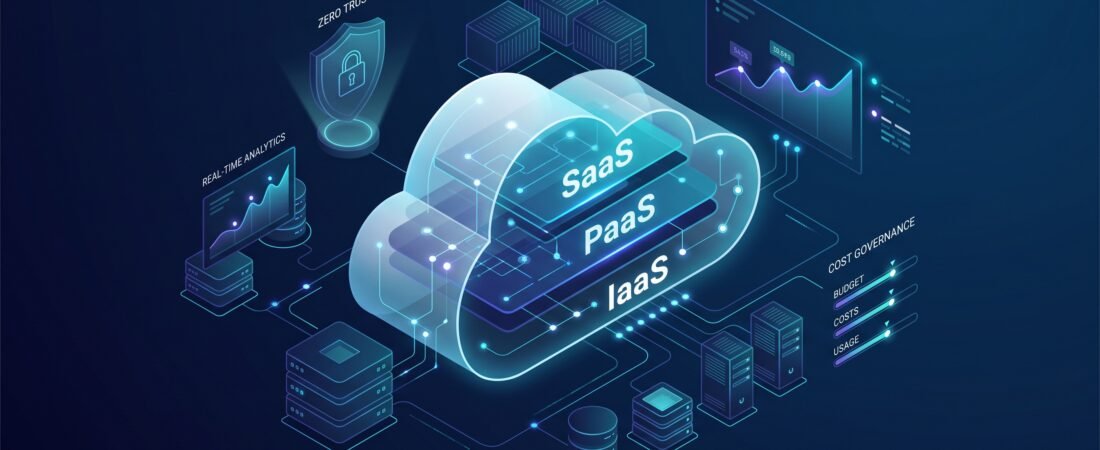
Choosing the correct cloud service model requires balancing administrative control against management overhead. The reference framework breaks down these layers into three primary operational tiers:
Infrastructure as a Service, commonly known as IaaS, provides foundational computing building blocks such as raw virtual machines, block storage, and virtual software-defined networks. In this environment, the cloud provider manages physical hardware, power, cooling, and virtualization hypervisors. The enterprise retains complete authority over operating system installation, runtime environments, security patches, middleware, and application code. This tier offers maximum flexibility, making it ideal for legacy system migrations and custom high-performance computational workloads.
Platform as a Service, or PaaS, removes the underlying operating system and virtual networking layer from the user’s daily responsibilities. Developers receive an optimized runtime environment equipped with managed databases, execution runtimes, and automated scaling policies. Teams focus exclusively on writing, testing, and deploying application logic while the cloud provider transparently manages operating system updates, capacity planning, and hardware maintenance. This approach significantly accelerates software delivery cycles for modern web applications and microservices.
Software as a Service, or SaaS, delivers complete, ready-to-use business software hosted and maintained entirely by third-party providers. End users interact with these applications directly through web browsers or mobile apps, requiring zero infrastructure setup beyond account management and identity policies. The guide helps technology teams evaluate where their business problems lie on this continuum, preventing organizations from over-engineering simple office workflows or over-simplifying complex, proprietary core systems.
Deployment Strategies: Public, Private, Hybrid, and Multi-Cloud
Beyond individual service tiers, organizations must establish where and how their infrastructure lives. No single deployment architecture fits every regulatory, security, and operational profile.
Public clouds host workloads on massive shared infrastructure operated by global technology giants, offering unmatched elasticity and global reach. Private clouds, conversely, dedicate hardware infrastructure exclusively to a single business, satisfying strict national sovereignty, legal, or industry compliance mandates at the cost of higher capital investment and ongoing maintenance.
The droven.io cloud computing guide places significant emphasis on hybrid cloud and multi-cloud strategies. A hybrid framework bridges private local data centers with public cloud networks, enabling sensitive financial or healthcare records to stay within secure corporate walls while dynamic customer applications scale across public servers during demand spikes.
Multi-cloud architectures distribute critical workloads across multiple independent public cloud vendors to reduce vendor lock-in and enhance disaster tolerance. However, the guide offers a practical word of caution regarding this model. While multi-cloud strategies prevent over-reliance on a single vendor, they dramatically heighten administrative friction, complicate cross-cloud networking, and duplicate security monitoring burdens. Organizations are encouraged to adopt multi-cloud designs only when distinct business needs justify the added operational overhead.
Cloud Security and the Zero Trust Imperative
Security represents one of the most critical and frequently misunderstood aspects of enterprise cloud adoption. Many early-stage adopters assume that migrating to high-grade certified infrastructure automatically guarantees immune digital systems.
The curriculum clarifies this misconception through the shared responsibility model. Cloud providers assume responsibility for the security of the cloud, which includes physical data center security, hardware integrity, firmware updates, and host virtualization layers. The client organization retains complete responsibility for security in the cloud, covering identity and access permissions, network firewalls, data encryption, operating system patches, and application vulnerabilities.
To navigate this shared dynamic, the guide advocates for a comprehensive Zero Trust security architecture. In modern perimeter-less cloud networks, traditional perimeter defenses are no longer sufficient. Zero Trust operates under the fundamental assumption that threats exist both inside and outside the network. Every access attempt, machine-to-machine application programming interface call, and database query must be continuously authenticated, explicitly authorized, and encrypted, regardless of user location or network origin. Applying strict least-privilege policies, rotating administrative credentials, and enforcing robust multi-factor authentication are highlighted as mandatory foundational steps.
Cloud Financial Management: FinOps and Cost Governance
The financial promise of the cloud is its variable expense structure, replacing upfront capital expenditure with predictable operational spending. Yet, without disciplined governance, this elasticity can quickly become a financial liability. Organizations frequently experience cloud billing surprises driven by idle test instances, forgotten storage snapshots, unmonitored serverless functions, and unoptimized network bandwidth consumption.
The droven.io cloud computing guide underscores that cost optimization is an ongoing operational practice known as FinOps, rather than an occasional administrative clean-up. Effective cloud financial management starts with complete organizational visibility through comprehensive asset tagging. Every provisioned cloud asset must carry metadata indicating which team, environment, and business project owns the resource, making departmental spending accountable.
Furthermore, teams must actively practice rightsizing, continuously evaluating system telemetry to downsize over-provisioned virtual instances that consume only a fraction of their allocated capacity. By pairing rightsizing with automated shut-off scripts for non-production environments and committing to reserved capacity discounts for steady-state workloads, businesses can reduce unnecessary cloud expenditures by substantial margins.
Practical Real-World Applications and Enterprise Use Cases
Theoretical infrastructure concepts become truly valuable when connected to concrete operational scenarios. The educational framework details how organizations leverage modern cloud principles across diverse, real-world environments:
Startups and agile development teams utilize cloud primitives to launch software prototypes in hours without upfront hardware investments. By composing serverless functions, managed authentication endpoints, and scalable relational databases, early-stage ventures deliver high-performance applications to global audiences while maintaining minimal burn rates.
Traditional enterprise organizations deploy cloud systems to overhaul disaster recovery and business continuity strategies. Instead of maintaining costly duplicate physical data centers on standby, enterprises replicate live production databases asynchronously to remote cloud availability zones. In the event of a regional outage or ransomware compromise, infrastructure-as-code scripts can spin up a fully functioning mirrored environment in minutes, minimizing downtime and data loss.
High-growth software companies rely on container orchestration and cloud networking to manage volatile traffic spikes. During promotional events, breaking news cycles, or seasonal shopping peaks, automated scaling policies dynamically provision additional server capacity, scaling back down when user traffic normalizes to prevent unnecessary billing.
Strategic Benefits of Adopting the Droven.io Guide
Adopting the structured, objective perspective provided by the droven.io cloud computing guide offers significant advantages for technical and business leaders alike.
First and foremost, it bridges the persistent communication gap between technical engineering teams and non-technical executive leadership. By explaining complex concepts such as network latency, containerization, and shared security models in clear, accessible language, the guide enables executives to evaluate technology investments with confidence and clarity.
Additionally, the guide acts as a protective shield against vendor lock-in. When engineering teams build systems around open, vendor-neutral standards rather than proprietary, platform-specific services, the organization maintains strategic leverage. Teams can migrate components freely as commercial pricing models and business needs evolve over time.
Finally, it accelerates professional career development. For students, junior developers, and systems administrators transitioning into cloud engineering roles, having access to an organized, plain-language roadmap helps demystify certification pathways and real-world system design.
Conclusion
The cloud has become the undisputed engine of modern global enterprise, powering everything from agile digital startups to massive industrial data systems. Yet, the path toward a secure, high-performing, and cost-effective cloud infrastructure remains filled with administrative, architectural, and financial hurdles.
Mastering this dynamic landscape requires unbiased, disciplined education rather than vendor-sponsored marketing materials. The droven.io cloud computing guide provides technology practitioners, executives, and learners with the exact strategic foundation needed to navigate modern infrastructure decisions. By emphasizing fundamental service models, Zero Trust security policies, proactive FinOps governance, and sustainable architecture design, this comprehensive resource empowers organizations to harness the transformative potential of the cloud with clarity, efficiency, and long-term resilience.
Frequently Asked Questions
What is the primary purpose of the droven.io cloud computing guide?
The primary purpose of the guide is to provide an accessible, vendor-neutral educational roadmap covering modern cloud computing fundamentals, architectural models, cost control strategies, and security frameworks. It is designed to help professionals, businesses, and learners understand complex cloud technology clearly before committing to infrastructure investments or vendor contracts.
Does Droven.io sell proprietary cloud software or web hosting services?
No, Droven.io is an independent editorial and educational content platform that does not sell proprietary software, hosting services, or vendor affiliate packages. Its sole mission is to publish plain-language, citation-grounded guides that evaluate technology categories objectively so that organizations can make their own informed operational decisions.
Who benefits most from reading the cloud computing guide?
The guide offers valuable insights for a diverse audience, including business leaders seeking to evaluate infrastructure spending, software developers designing scalable web architectures, cybersecurity professionals implementing Zero Trust controls, and aspiring IT engineers preparing for cloud career transitions.
What is the shared responsibility model explained in the guide?
The shared responsibility model is a foundational cloud governance framework that outlines the division of security obligations between the cloud provider and the customer. The provider manages the security of the underlying hardware, physical facilities, and virtualization layer, while the customer remains responsible for securing operating systems, configurations, user access privileges, network traffic rules, and stored data.
How does the guide help organizations control unexpected cloud expenses?
The guide addresses cloud cost overruns by outlining disciplined FinOps methodologies. It provides actionable guidance on resource tagging for departmental accountability, continuous performance rightsizing to eliminate over-provisioning, automated shutdown schedules for idle development environments, and structured commitments to reserved capacity pricing.