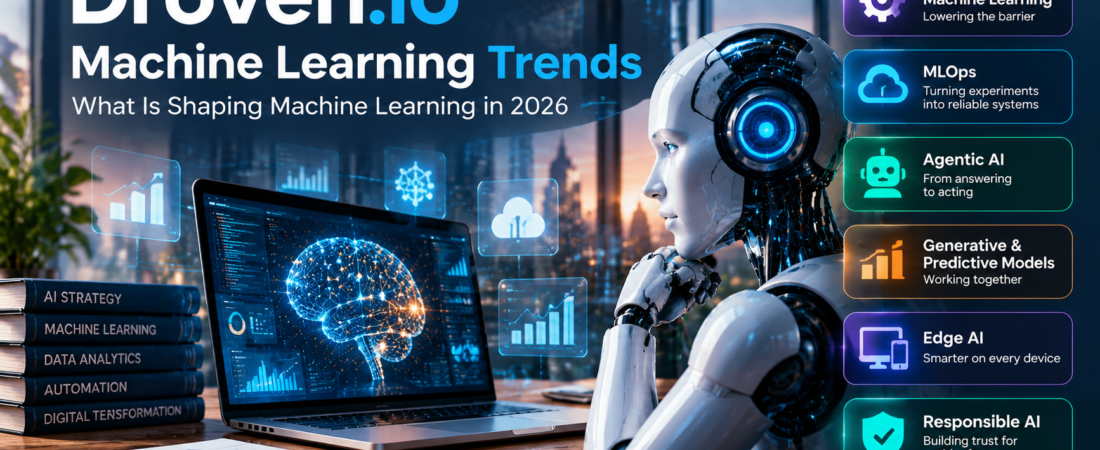
Machine learning used to be a topic mostly discussed by researchers and data scientists. Today it sits behind the recommendations on your phone, the fraud checks on your card and the forecasts that help a warehouse decide what to stock. As adoption has spread, so has the number of people searching for plain-language explanations of where the field is heading. That demand is a big part of why the phrase droven.io machine learning trends has become a common search.
This article explains what that phrase means, which trends are shaping machine learning in 2026, and why each one matters for businesses, students and curious readers. It is written so you can follow the ideas without a technical background or a pile of extra tabs.
What People Mean by Droven.io Machine Learning Trends
Droven.io is an editorial technology website. Its homepage is built around articles on artificial intelligence, software, digital transformation and tool reviews, not around a product you log into. It does not build or sell machine learning software. When people search for droven.io machine learning trends, they are usually looking for the site’s coverage of how machine learning is being adopted, or for a clear overview of the current direction of the field.
That second meaning is worth stating openly. Many third-party pages that use this phrase are really describing general machine learning developments, such as automation of model building, running models on devices, and responsible use of AI. Those developments are not unique to any one website. They are the shared story of the industry in 2026, and this article treats them that way, using the site’s focus on practical, business-friendly explanations as the lens.
Why Machine Learning Is Entering Its Practical Era
A few years ago, much of the excitement around machine learning came from demonstrations. A model could identify an image, translate a sentence or beat a human at a game, and that was impressive enough. The mood in 2026 is different. Companies now ask whether a model can run reliably every day, whether it can be audited, and whether the cost makes sense.
This change in attitude explains most of the trends below. Machine learning is less about proving that something is possible and more about making it dependable, affordable and trustworthy. Teams are investing in the tools and habits that keep models working after the launch announcement fades, and that is where much of the real progress is happening.
The Main Machine Learning Trends to Watch
Automated Machine Learning Lowers the Barrier
Automated machine learning, often shortened to AutoML, handles tasks that once required a specialist, such as preparing data, choosing which features matter and comparing different model types. A marketing analyst or a small business owner can now test a forecasting idea without writing every step by hand.
The benefit is speed and access. The risk is overconfidence. An automated tool will happily train a model on messy or biased data and present a result that looks polished. Teams that get good outcomes treat these tools as accelerators for people who understand their data, not as replacements for that understanding.
MLOps Turns Experiments Into Dependable Systems
Training a model is only the beginning of its life. Once it is deployed, the world changes around it. Customer behavior shifts, new products appear and the data the model sees no longer matches the data it learned from. This gradual decay, often called drift, quietly reduces accuracy if no one is watching.
MLOps, short for machine learning operations, is the discipline that deals with this reality. It covers how models are deployed, versioned, monitored and retrained. If you think of a model as a car, MLOps is the maintenance schedule, the dashboard warnings and the garage. As more companies depend on models for everyday decisions, this unglamorous work has become one of the most important trends of all.
Agentic AI Moves From Answering to Acting
Traditional machine learning responds to an input and returns an output, such as a prediction or a label. Agentic systems go a step further. They pursue a goal, break it into steps, use software tools along the way and adjust based on what happens.
A practical example is a support workflow where a system reads a customer request, checks an order record, drafts a response and flags unusual cases for a human. The appeal is clear, because it saves time on repetitive work. The challenge is oversight. When a system can take actions, organizations need clear limits, logs and human checkpoints so that mistakes are caught early.
Generative and Predictive Models Work Together
Generative AI, which produces text, images and code, gets most of the headlines. Predictive machine learning, which forecasts outcomes such as demand, risk or churn, has quietly powered business decisions for much longer. In 2026 the two are increasingly combined.
A common pattern is to let a predictive model produce a score or a forecast and then let a generative model explain the result in plain language. A manager can then read a short summary of why sales may dip next month rather than staring at a chart. Generative models are also built on machine learning foundations, so the two fields are less separate than they first appear.
Multimodal Models Understand More Than Text
Early language models handled text. Multimodal models handle several kinds of input at once, including text, images, audio and video. This opens up uses that single-format systems could not manage well, such as reading a scanned form, describing a photograph or answering questions about a recorded meeting.
For everyday users, this means interacting with AI in more natural ways. Instead of typing a careful description, you may simply show an image and ask a question about it. For businesses, it means documents, pictures and recordings that were once hard to analyze are becoming usable data.
Machine Learning Moves to the Edge
For years, most models ran in large data centers. Edge machine learning shifts some of that work onto phones, cameras, vehicles and factory sensors. The model runs close to where the data is created.
There are good reasons for this. Responses are faster because data does not need to travel far. Systems keep working when the connection is weak. Sensitive information, such as a voice recording or a health reading, can stay on the device. Smaller, more efficient models make this possible, and it is one of the clearest ways machine learning is becoming part of ordinary products.
Responsible AI and Governance Become Standard Practice
As models influence hiring, lending, healthcare and security, questions about fairness, transparency and accountability have moved from conference panels into project plans. Regulation is also developing in several regions, which gives companies another reason to document how their systems work.
Responsible AI in practice means checking training data for bias, testing how a model behaves on different groups, keeping records of decisions and being able to explain results in understandable terms. It is not only a legal concern. A model that people do not trust is a model they will not use, so responsible design is increasingly seen as part of building a successful product.
Privacy-Preserving Techniques and Synthetic Data
Machine learning needs data, but data often contains personal information. Two techniques address this tension. Federated learning trains a shared model across many devices without collecting everyone’s raw data in one place. Synthetic data creates artificial records that mimic the patterns of real ones so teams can test and train without exposing real individuals.
Both are still maturing and neither is a magic fix, since poorly generated synthetic data can carry hidden flaws. Even so, they point to a future where useful models and strong privacy protection can coexist rather than compete.
Industry-Specific Models Gain Ground
General-purpose models are impressive, but many organizations need something tuned to their field. A model trained to understand medical imaging, legal contracts or machine sensor readings can outperform a general one on that narrow task, often at lower cost.
This trend matters because it shifts the question from which model is biggest to which model fits the job. Smaller, focused models are easier to run, easier to check and easier to keep within a company’s own systems.
Where These Trends Are Being Used
The practical effects show up across many fields. In manufacturing, models predict equipment faults before a breakdown, and quality checks use cameras trained to spot defects. In finance, systems watch transactions for unusual patterns that may signal fraud. In healthcare, models help analyze images and support planning, always alongside human professionals. In marketing, machine learning supports audience grouping, content recommendations and forecasting of campaign performance.
Security teams also use machine learning to detect unusual network behavior, identify phishing attempts and classify malicious software. At the same time, attackers can use similar tools, which is a reminder that security around machine learning systems deserves attention too. Droven.io’s recent coverage, such as pieces on machine learning in precision manufacturing and on startups that make data work verifiable, reflects this applied direction.
Challenges Behind the Excitement
Every trend above comes with obstacles. Data quality remains the most common one. A model is only as good as the examples it learns from, and incomplete or biased data produces unreliable results no matter how advanced the method. Skills are another gap, since organizations need people who understand both the technology and the business problem.
Cost and energy use also deserve honest discussion. Large models can be expensive to train and run, which is one reason smaller and edge-based approaches are attracting interest. Finally, there is the question of expectations. Machine learning rarely delivers value overnight, and projects that begin with a clear, measurable goal tend to fare better than those that begin with enthusiasm alone.
How Readers Can Use This Knowledge
If you run or work in a business, a sensible approach is to begin with one concrete problem, such as forecasting demand or sorting support requests, and check whether your data is good enough to support it. Learn the basics of monitoring before you deploy anything, and decide in advance who is responsible when a model gets something wrong.
If you are a student or career changer, focus on fundamentals such as statistics, data handling and clear communication. Tools change quickly, but the ability to frame a problem and judge a result stays valuable. For both groups, reading explainer-style coverage from sites like droven.io can help you build vocabulary and spot patterns, while official documentation and independent research are better for exact technical details.
Conclusion
The Droven.io machine learning story of 2026 is one of maturity. Automated tools make experimentation easier, MLOps keeps models healthy after launch, agentic systems begin to take on multi-step work, and multimodal and edge approaches bring intelligence into more everyday settings. Alongside them, responsible AI, privacy-preserving methods and specialized models address the question of whether these systems can be trusted.
When people search for droven.io machine learning trends, they are really looking for a clear, practical picture of this shift. The most useful takeaway is that machine learning has moved from impressive demonstrations to everyday infrastructure, and the organizations and individuals who understand both its promise and its limits will be best placed to benefit.
Frequently Asked Questions
What does droven.io machine learning trends mean?
It refers to the machine learning topics covered by droven.io, an editorial technology site, and more broadly to the general developments shaping the field in 2026, such as AutoML, MLOps, edge machine learning and responsible AI. It is a subject area, not a software product.
Is droven.io a machine learning tool?
No. Droven.io is a content publication that explains AI and technology topics. It does not build, sell or host machine learning software, so the tools it discusses come from other companies.
What are the biggest machine learning trends in 2026?
The most discussed trends include automated machine learning, MLOps, agentic AI, the combination of generative and predictive models, multimodal systems, edge machine learning, responsible AI and privacy-preserving methods such as federated learning.
What is MLOps and why does it matter?
MLOps stands for machine learning operations. It is the set of practices for deploying, monitoring, updating and retraining models after launch. It matters because models lose accuracy over time as real-world data changes, and without monitoring those problems go unnoticed.
How can beginners start learning about machine learning trends?
Start with clear explainer articles to learn the vocabulary, then build a foundation in basic statistics and working with data. Try a small project with a simple dataset, and use official documentation and trusted independent sources when you need accurate technical detail.
For More, Visit Excel Mind Agency Blog