
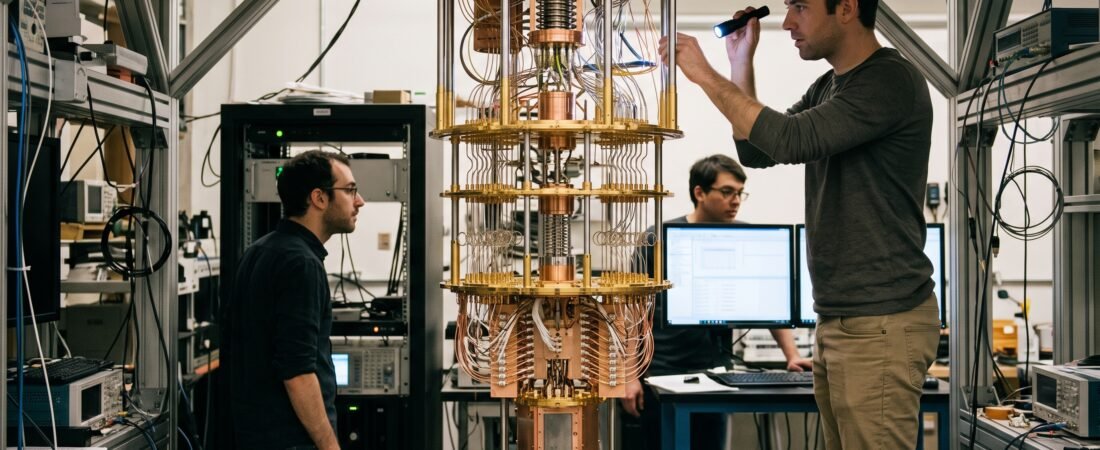
For many years, quantum computing sat in a strange place between scientific promise and practical doubt. Researchers kept saying that these machines would one day solve problems that ordinary computers cannot touch, while skeptics pointed out that the hardware was fragile, noisy and far too error-prone to be useful. Then 2024 arrived, and the conversation shifted. The Explore the latest breakthroughs in quantum computing 2024, from Google’s Willow chip to logical qubits, IBM’s roadmap and new post-quantum standards. were not about bigger headlines or louder claims. They were about something far more important: making quantum machines reliable enough to take seriously.
This article walks through the most important developments of that year, explains the science in plain language, and shows what they mean for businesses, governments and everyday internet users. You do not need a physics background to follow along. By the end, you should understand why 2024 is widely seen as a turning point for the field.
Why Quantum Computing Matters in the First Place
A classical computer, whether it is your phone or a giant data center, stores information as bits. Each bit is either a zero or a one. A quantum computer uses qubits, which can exist in a blend of zero and one at the same time, a property known as superposition. Qubits can also be linked through entanglement, so that the state of one is tied to the state of another no matter how far apart they are.
When these properties are used carefully, a quantum computer can explore many possibilities in a way that no conventional machine can imitate efficiently. That does not make it faster at everything. Sending an email or running a spreadsheet gains nothing from quantum hardware. The advantage appears in specific areas such as simulating molecules, optimizing complex logistics, and breaking certain kinds of encryption.
The catch is that qubits are extremely sensitive. Heat, vibration, stray electromagnetic noise and even the act of measuring them can destroy their delicate state. This is why error correction became the central challenge of the entire field, and it is also why the most meaningful breakthroughs in 2024 were about errors rather than raw size.
Google Willow and the Error Correction Milestone
The biggest story of the year came in December 2024, when Google Quantum AI introduced a chip called Willow. It contains 105 superconducting qubits, which is not an enormous number by itself. What made it remarkable was how those qubits behaved when they were grouped together to protect information.
In quantum error correction, many physical qubits are combined to form a single, more stable logical qubit. For almost three decades, scientists faced a frustrating problem: adding more physical qubits usually introduced more errors than it removed, because each additional qubit was another thing that could go wrong. Google reported that Willow finally reversed this trend. As the team scaled the error-correcting grid from a small patch to a larger one, the logical error rate dropped by roughly half each time. That behavior is called operating below the threshold, and researchers had been chasing it since the 1990s.
Why the Below-Threshold Result Is So Important
Think of it like building a bridge. For years, every time engineers added more support beams, the structure somehow became weaker. Willow showed that, at least in this experiment, adding more support actually made the bridge stronger. This result, published in the journal Nature, suggests that building a large and dependable quantum computer is a real engineering path rather than a theoretical dream. It does not mean the problem is solved, since useful applications will require far more logical qubits than any machine had in 2024, but it removed a major doubt about whether the approach could work at all.
The Random Circuit Sampling Claim
Google also announced that Willow completed a benchmark task, known as random circuit sampling, in under five minutes. The company estimated that one of the world’s fastest supercomputers would need an almost unimaginably long time to do the same thing. It is worth being honest about what this means. The benchmark was designed to be hard for classical machines and has little practical use on its own. It is best understood as a demonstration of raw capability, while the error correction result is the part with lasting scientific weight.
Logical Qubits Move From Theory to Lab Reality
Google was not alone. Throughout 2024, several groups showed that logical qubits could be created and used in real experiments, which many experts had expected to take much longer.
In April 2024, Microsoft and Quantinuum announced that they had used Quantinuum’s trapped-ion hardware to create logical qubits with error rates far lower than the underlying physical qubits, reporting an improvement of several hundred times. Later in the year, the two companies pushed this further and described experiments involving a dozen logical qubits. Trapped-ion systems work differently from Google’s superconducting chips. They hold individual charged atoms in place with electromagnetic fields and control them with lasers, and they tend to offer very high accuracy for each operation.
Neutral atom technology also made headlines. Atom Computing, working with Microsoft, reported entangling a couple of dozen logical qubits late in the year, which was among the largest such demonstrations at that time. Meanwhile, researchers at Harvard and the company QuEra built on their earlier work with arrays of neutral atoms, showing that thousands of atoms could be held and controlled in ways that point toward much larger machines. Each of these efforts takes a different physical route, and the fact that several of them reached similar milestones in the same year gave the field new confidence.
IBM and the Push Toward Practical Scale
IBM took a different philosophy in 2024. Rather than chasing the biggest chip, the company focused on quality, connectivity and a clear roadmap. After unveiling a 1,121-qubit processor called Condor at the end of 2023, IBM concentrated on its Heron processors, which have fewer qubits but much lower error rates and better performance. At its developer conference in November 2024, IBM presented an upgraded Heron chip with 156 qubits and described improvements that let it run more complex circuits with greater accuracy.
IBM also continued to promote its modular approach, in which several processors are linked together inside systems like IBM Quantum System Two. The idea is that future quantum computers will not be single giant chips but networks of smaller ones working together, much like modern data centers are built from many servers. This matters because manufacturing one flawless enormous chip is extremely difficult, while connecting smaller, well-tested modules is a more realistic engineering goal.
Post-Quantum Cryptography Becomes Official
Not every important development in 2024 happened in a laboratory. In August 2024, the United States National Institute of Standards and Technology released its first finalized standards for post-quantum cryptography. These are encryption methods designed to remain secure even against a future quantum computer powerful enough to break today’s widely used systems.
Why Ordinary Users Should Care
Much of the security that protects online banking, private messages and stored data relies on mathematical problems that a large quantum computer could eventually solve quickly. Experts also warn about a practice sometimes described as harvest now, decrypt later, where attackers collect encrypted data today in the hope of unlocking it once quantum technology matures. The new standards give organizations a clear set of tools for upgrading their defenses before that risk becomes real.
Technology companies began acting on this during the year. Apple added a post-quantum protocol to iMessage, and the Signal messaging service upgraded its own key exchange to include quantum-resistant protection. For the average person, this work happens quietly in the background, but it is a direct and practical consequence of quantum progress.
Real-World Applications Taking Shape
Because 2024 delivered better error handling, the conversation about applications became more grounded. Researchers are exploring several areas where quantum computers could eventually offer a genuine edge.
In chemistry and materials science, simulating how molecules behave is extremely difficult for classical machines, since the underlying physics is itself quantum. Better simulation could speed up the search for new batteries, fertilizers, catalysts and medicines. In finance, firms are testing quantum methods for portfolio optimization and risk analysis. In logistics, companies are looking at routing and scheduling problems that grow impossibly complex as variables increase. Energy producers are studying how quantum tools might help with grid management and the design of cleaner materials.
It is important to keep expectations realistic. Most of these applications still need machines with thousands of reliable logical qubits, a level the industry had not reached by the end of 2024. Current devices are mostly used for research, benchmarking and early experiments. What changed in 2024 is that the roadmap from today’s hardware to useful hardware looked clearer and more credible than before.
Challenges That Remain
Despite the optimism, serious obstacles remain. Scaling up from a handful of logical qubits to the many thousands needed for large applications will require enormous advances in manufacturing, cooling, control electronics and software. Superconducting machines need to operate at temperatures colder than outer space, which demands complex and expensive equipment. Trapped-ion and neutral atom systems face their own difficulties with speed and with moving information efficiently between large numbers of qubits.
There is also a talent and cost challenge. Quantum engineers are in short supply, and building these machines is expensive. Governments across the United States, the United Kingdom, Europe and Asia continued to increase their funding in 2024, treating quantum technology as a matter of both economic and national security interest.
What the latest breakthroughs in quantum computing 2024 Mean Going Forward
Looking back, 2024 will probably be remembered less for any single announcement and more for the way several independent results pointed in the same direction. Error rates fell, logical qubits became real, different hardware approaches matured side by side, and governments and companies started preparing their security systems for a quantum future. For the first time, serious researchers spoke about useful quantum computers as an engineering timeline rather than a distant hope.
Conclusion
The latest breakthroughs in quantum computing 2024 changed how experts talk about the technology. Google’s Willow chip demonstrated that error correction can improve as systems grow, Microsoft, Quantinuum and Atom Computing showed that logical qubits are achievable, IBM advanced a modular and quality-focused roadmap, and NIST gave the world its first official standards for encryption that can resist quantum attacks. None of this means everyday quantum computers are around the corner, but it does mean the foundation is stronger than it has ever been. Anyone who follows technology, works in security, or plans business strategy has good reason to keep watching this field closely.
Frequently Asked Questions
What was the biggest latest breakthroughs in quantum computing 2024?
Most experts point to Google’s Willow chip and its error correction result. By showing that logical error rates fall as more qubits are added to the system, it passed a threshold that researchers had pursued for roughly thirty years and made large-scale quantum computing look achievable.
Can quantum computers break encryption today?
No. Current quantum computers are far too small and error-prone to break modern encryption. However, a sufficiently powerful machine could do so in the future, which is why NIST released post-quantum cryptography standards in 2024 and why companies are already upgrading their security.
What is a logical qubit?
A logical qubit is a more reliable unit of quantum information created by combining many physical qubits and using error correction to protect the data. Because physical qubits are fragile, logical qubits are essential for running long and complex calculations.
How many qubits does a useful quantum computer need?
Estimates vary by application, but many useful tasks are expected to require thousands of high-quality logical qubits, which could translate to millions of physical qubits with current methods. Machines in 2024 were still far below that level.
When will quantum computing affect everyday life?
Most people will notice the effects indirectly, through better security, improved materials and faster drug research, rather than by using a quantum computer themselves. Experts disagree on exact timing, but many expect meaningful commercial uses to appear gradually over the next decade rather than all at once.